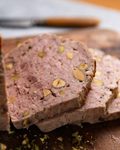
Country Terrine - pork and pistachio
Recipe video above. I made countless terrines during my restaurant days back in France. I wanted to bring you a version that tastes just like the ones I made professionally, but one any home cook can make. It took over 40 attempts, but I think this recipe I landed on is every bit as good as the best terrines you'll find in France.Made with pork, chicken livers, brandy and pistachios - a classic combination - it's rich, savoury and so soft you can almost spread it onto bread with a knife.Serve with crusty bread, cornichons and Dijon mustard as a light snack, for picnics, or as part of a grazing board. Or add a simple side salad to turn it into a lovey French-style meal.** NOTE: Don't attempt this without a thermometer. Removing the terrine from the oven at exactly the right temperature is the key to its blushing pink colour and perfect texture. **
Servings: 15 slices
Calories: 428cal
Ingredients
MARINADE:
- 800g / 28oz pork belly mince , ground pork belly (Note 1)
- 400g / 14oz pork mince , ground pork, regular or lean (Note 1)
- 250g / 9oz chicken livers , cleaned, diced 1cm/0.4" (Note 2)
- 4 tsp cooking / kosher salt
- 1 3/4 tsp black pepper
- 1/4 cup brandy , preferably cognac (Note 3)
CURING SALT OPTION (NOTE 4)
- 1/8 tsp curing salt (cure #1) - I do not use it (Note 4)
TERRINE MIXTURE:
- 15g / 1 tbsp unsalted butter
- 1 eschalot , finely diced (Note 5)
- 2 large eggs , (55g/2oz each in shell) - fridge cold is fine
- 2 egg yolks , from large eggs (55g/2oz each in shell) - fridge cold is fine
- 1/2 cup thickened cream (heavy cream)
- 1/2 heaped cup unsalted pistachios , no need to toast it (Note 6)
For serving
- Bread slices (I like baguettes)
- Dijon mustard
- Cornichons or other pickles
Instructions
ABBREVIATED RECIPE:
- Marinate the pork, chicken livers, salt, pepper and brandy overnight. Sauté the eschalot in butter for 3 min. Add to the marinated meat with the eggs, yolks, cream and pistachios, mix. Pack into loaf pan.
- Bake 25 min in hot water bath at 220°C / 430 °F (200°C fan) then cover with foil, reduce to 170°C / 340°F (150°C fan) and cook until the centre reaches 68°C / 155°F (about 75 min). Rest 2 hrs, fridge overnight, serve.
FULL RECIPE:
Make terrine mixture:
- Marinate (Note 7) - Place both pork minces and chicken livers in a large bowl. Add salt, pepper and brandy. Mix well with your hands until everything is evenly coated. Cover and leave in the fridge to marinate overnight.
- Preheat oven to 220°C / 430 °F (200°C fan-forced).
- Sauté eschalot - Melt the butter in a small frying pan over medium heat. Add the eschalot and cook for 3 minutes, stirring regularly, until softened but don't let it go golden. Set aside to cool slightly.
- Terrine mix - Place the marinated meat in the bowl of a stand mixer. Add the cooked eschalot, eggs, egg yolks, cream and pistachios. Using the paddle attachment, mix on low speed for 30 seconds then on medium speed for another 30 seconds until well combined. It should be mostly smooth (not pureed) with a slightly coarse texture that gives the terrine its rustic look and a better bite. (Note 8 for no stand mixer)
- Fill the terrine - Transfer the mixture to a loaf pan (21.5 x 11.5 x 7 cm / 4.5 x 8.5 x 2.75") by taking a handful of the mixture and slamming it firmly into the pan. Repeat this 4 - 5 times, pressing the mixture down between each addition. This removes air pockets and packs the meat tightly, which gives a smooth terrine that slices cleanly without brown spots from air pockets. Give the terrine a few firm taps on the bench, this will help mixture to settle and become more compact before baking.
Cook:
- Bake in a bain-marie (water bath) - Place the loaf pan in a roasting pan. Pour boiling water around it until it reaches halfway up the sides of the loaf pan. Bake for 25 minutes. Cover the terrine loosely with foil, still in the water bath. Lower oven to 170°C / 340 °F (150°C fan), and bake until the internal temperature reaches 68°C / 155°F, around 75 minutes. (Note 9)
- Rest (Note 9) - Remove from the oven. The top looks quite pale but don't worry, the colour will darken as it cools. Leave the terrine on the counter for 2 hours. As the terrine rests, the juices and rendered fat released during cooking slowly soak back into the meat, making it wonderfully tender and soft. The internal temperature will rise to about 75°C / 167°F after 15 minutes, then slowly drop to room temperature.
- Refrigerate overnight - Cling wrap the terrine and refrigerate overnight. As it chills, it will allow the flavours to meld and develop. Don't skip this, it's well worth the wait!
- Un-mould - The next day, un-mould. Run a blow torch briefly over the outside of the loaf pan to warm it slightly, then invert onto a board or platter. Alternatively, dip the pan in hot water, or warm it briefly over a low flame on the stove.
- Slice and serve at room temperature. I cut mine 1cm / 0.4" thick but it's really up to you. The beautiful blush pink colour fades after slicing - that's perfectly normal as the meat oxidises when exposed to the air.
- Serving - Serve the terrine with slices of crusty baguette, pickles and mustard. Spread bread with a little mustard, top with a piece of the terrine and a pickle. Then enjoy. You've earned it!
Notes
1. Pork belly mince - Fatty pork is essential for a terrine that is rich, tender and sliceable, rather than dry and crumbly like a meatloaf. Ask your butcher to mince pork belly for you (make sure the rind is cut off), or if buying pre-minced pork, make sure it is a very fatty one. Compare it to the photo in the Ingredients section above - it should be pale pink with plenty of visible white flecks of fat.
Regular pork mince - I use a combination of both fatty and regular pork mince to balance the flavour and texture. Using just fatty pork would be too rich. You can use regular pork mince (around 15% fat) or lean (around 10% fat).
2. Chicken livers - These add richness to the terrine without making it taste strongly of liver. Trim away any green or yellowish spots (these are bitter), then remove any obvious sinew or tough connective tissue. There's no need to be too fussy - small pieces of membrane will soften during cooking.
3. Brandy - This is a classic ingredient in terrine. There is no need to use an expensive one. Cognac is preferred if you have it is the brandy that is typical used in France, but any brandy will do. It's also another opportunity to use the bottle you bought for Chicken Chasseur and Chicken Au Poivre! Non alcoholic substitute - You can use low sodium chicken stock or non alcoholic wine, though the terrine will not have the subtle flavour that brandy adds to it.
5. Eschalots - Also known as French onions or shallots (US name), these are the little onions that are purplish/white inside. They bring a sweeter, more delicate flavour to the terrine than regular onions, and are also finer so they almost disappear in the terrine.
6. Pistachios - The classic nut choice. I'd rather leave it out than use a different type of nut.
7. Marinating - For the best flavour, marinate the meat overnight. If you forget or don't have the time, you'll still end up with a good terrine, but it won't be nearly as good. The overnight marinade gives the brandy and seasonings time to penetrate the meat instead of just sitting on the surface. If you have the time, I really recommend not skipping this step, it makes a noticeable difference.
8. Mixing the terrine - If you don't have a stand mixer, it can be done by hand. Don't use a food processor, it's too powerful. Whisk together eggs, cream and eschalots (including residual butter in pan) in a large bowl. Add marinated meat and pistachios, use your hands to mix well.
9. Internal temperature - An oven safe thermometer is useful here but if you don't have one, check first at 60 minutes using a regular meat thermometer.
10. Resting - Like cooking any meat, resting lets the juices and fat around the terrine be absorbed back into the meat, keeping it moist and tender.
Leftovers and storage - Store the terrine in an airtight container in the fridge for up to 5 days. In fact, it's even better on the second or third day as the flavours continue to develop.
It's suitable for freezing but I recommend slicing it first, then wrapping the slices individually well so you can thaw only what you need. The slice freeze well, but it will lose a little of its silky, tender texture after thawing. Can keep for 3 months.
Nutrition per serving.
Nutrition
Calories: 428cal | Carbohydrates: 1g | Protein: 14g | Fat: 40g | Saturated Fat: 15g | Polyunsaturated Fat: 4g | Monounsaturated Fat: 17g | Trans Fat: 0.05g | Cholesterol: 174mg | Sodium: 676mg | Potassium: 241mg | Fiber: 0.1g | Sugar: 0.4g | Vitamin A: 2063IU | Vitamin C: 4mg | Calcium: 22mg | Iron: 2mg